Your submersible pumps were most probably installed on 20ft sticks of galvanized steel pipe. These…
Boreline FlexiRiser and Submersible Pumps
There’s No Silver Bullet, But There is Hose
From E&MJ – August 2025
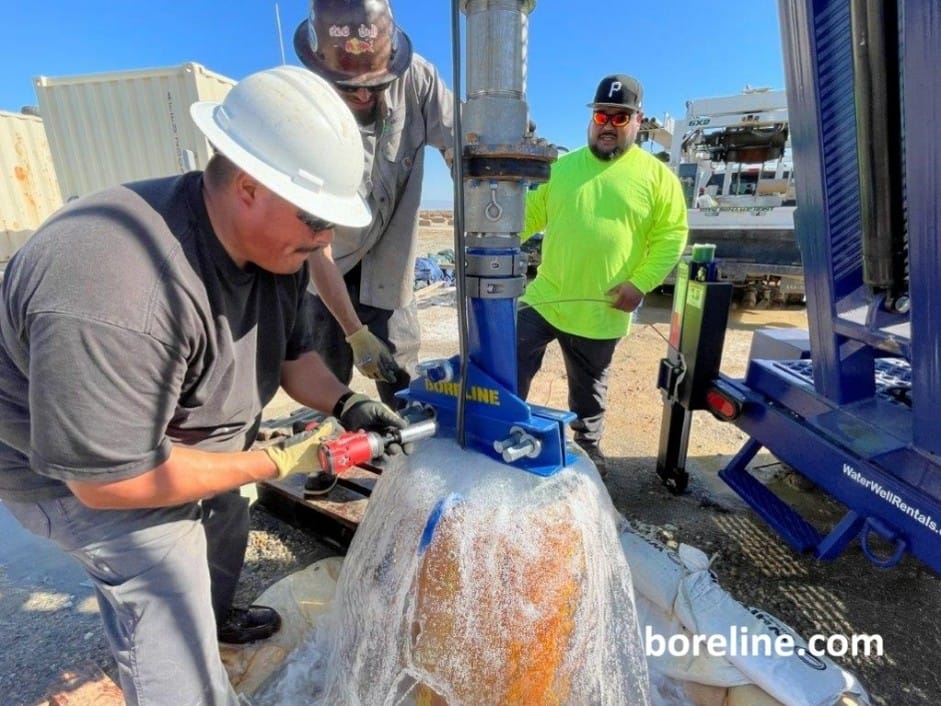
Boreline FlexiRiser in Artesian Dewatering Well
Hose Solutions Inc. said the company is developing the Boreline FlexiRiser to support deepening mines. “We see the future moving towards bigger pumps and deeper wells,” said CEO Nicolas Steverlynck.
Currently, Boreline FlexiRiser hose for well pump applications can be up to 8 in. (200 mm) in dia. and up to 300 m long. “We have a new 3-in. (75-mm) and 4-in. (100 mm) DeepSet Boreline FlexiRiser that is now available for continuous 1,312-ft (400 m) depth settings,” he said. “We are working on a 6-in. (150-mm) version as well.”
Boreline FlexiRiser is described as a high-performance, layflat-type hose that replaces rigid pipes used with submersible well pumps. “Rather than install submersible pumps on rigid steel pipe, Boreline is available in one, continuous length, allowing for a quicker, more efficient and safer pump installation and retrieval process,” Steverlynck said.
“Submersible well pumps age and corrode and need to be changed out when they fail,” he said. They also need to be relocated during blasting. “Pulling pumps that are set on 20-ft (6.1-m) sticks of steel pipe is a tough, time-consuming and unsafe job. In bad weather or windy conditions, it is most often not possible.” It is also labor- and resource-intensive.
In contrast, “Boreline FlexiRiser has no joints or connections,” he said. It is made of “high-tenacity, polyester fibers, which are circular-woven.” Thus, the “fibers appear vertically and horizontally in the hose to produce a hose jacket with no seam.” The construction supports “high pressures (up to 900 psi or 62 bar) and tensile strengths (up to 45,000lbs or 200kN).” Polyurethane is integrated in the weave for “great impact resistance” and “good chemical resistance.”
If it fails, the hose will “only burst vertically allowing the water, the biggest contributor to weight, to drain from the column,” Steverlynck said. The burst will not compromise the strength of the hose, “and you can easily still pull the pump and Boreline out of the well.”
Boreline FlexiRiser is deployed as a single, continuous hose with one fitting that screws into the pump and another that connects to the base plate or elbow at the surface. Boreline FlexiRiser Stainless-Steel fittings have “standard NPT or BSPT threads on the one end and grooves on the other end,” he said. “The hose slides over the groove-end and two separate clamps compress the Boreline FlexiRiser into these grooves to complete the connection.”
Because it is non-corrosive and flexible, “there is no internal scaling that ever takes place,” Steverlynck said. “This is a big deal for pumps that are set in wells with high concentrations of minerals.” Those two qualities offer several benefits, foremost of which may be improved safety.
“Pumps set on Boreline FlexiRiser are safer and quicker to install and retrieve,” he said. “Because steel pipes corrode, pulling these large, bulky pipes from wells is unpredictable and unsafe. The power cable has to also be separated from the drop pipe before it is laid on the ground and is usually rolled up next to the well. The entire footprint around the well is a bit of a safety hazard.”
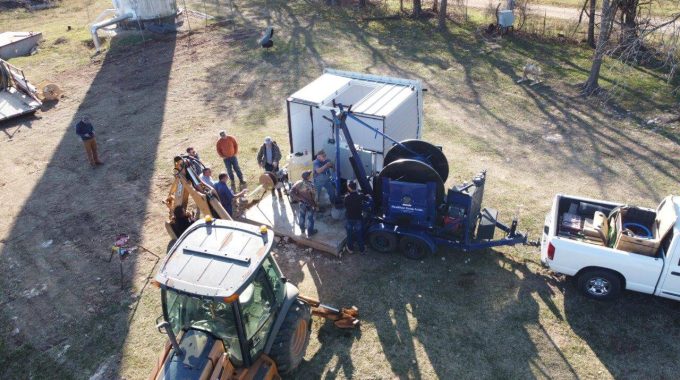
In contrast, “there is almost no touching or handling of the hose from start to finish,” Steverlynck said. “It is all just rolled-up with the power cable,” he said. “Depending on the length of the pump and motor and the height of the well casing above the ground level, a telescopic boom can then lift the pump out the well.”
Because the hose flexes and con tracts, preventing scaling, it helps a pump system operate as designed. “When engineers spec a dewatering project that has pumps and pipe, they are actually only using the information in regards to a new pump and new pipe,” Steverlynck said. “Internal scaling causes the pump and motor to have to overcome more friction or more head.” Inefficiencies result.
But “with Boreline FlexiRiser, the head-loss you have on day-one is what you have for the life of the product because the Boreline is self-cleaning,” he said.
The hose also supports preventative maintenance of the pump, “something not often considered simply because, historically, steel pipe was the only option for use with submersible pumps,” Steverlynck said. “Servicing wells and pumps before they fail is a big value-add.”
The hose is also a turnkey solution. “It is a one-time buy,” he said. “We offer a 50-year warranty for standard water wells, while life expectancy is in excess of 100 years.” Boreline FlexiRiser launched in 1990 and was first deployed in South Africa “where we were working with DeBeers in Namibia,” he said. “It quickly spread to coal mines, including Anglo Coal and ISCOR, and the gold mines, including AngloGold and Glencor.”
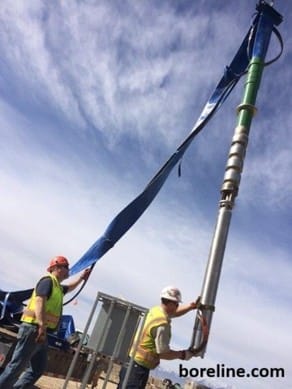
Boreline FlexiRiser with 150hp submersible pump
Elsewhere, a lithium brine operation adopted the hose because it prevents With a circular weave of polyester fibers and polyurethane, Boreline FlexiRiser reportedly maintains its tensile strength for its 50-year warranted life.
Originally, the miner used 6-in. dia. steel pipe, which would “reduce to 4” in about 2 months,” Steverlynck said. “In the old days, they would have a second set of drop-pipe at the surface that had dried over the 2 months and they would hit the pipe with a baseball bat to break-off the internal buildup.” Pipe was regularly being swapped-out. “This would have to be done on a continuous basis on hundreds of wells.”
The operation switched to Boreline FlexiRiser and an automatic valve at the surface. The valve opens and closes, causing the hose to expand and contract, “allowing all internal scaling to break-off, thereby keeping the original internal dia.”
A Nevada mine benefited from how Boreline FlexiRiser supports pump removal for repair and maintenance. The pump was at the end of 850 ft (260 m) of 3-in. hose, and a repair was required at the worst possible time.
“They had a failed pressure-transducer and needed to change this out,” Steverlynck said. “It was the middle of winter, with very cold weather, and if this pump was set on steel pipe, it would have taken them more than a day to pull these 42 sticks of steel pipe out the well and another day to lower the pump back into position,” he said. “Fortunately for them, this pump was set on Boreline FlexiRiser and they had our FlexiRiser Pump Puller onsite for this change-out.”
Boreline FlexiRiser is also deployed to extractor wells in in-situ recovery mi ing. “In these situations, water chemistry can be very corrosive and steel pipe and pumps do not last, so stainless steel is usually used,” Steverlynck said. “Build-up around the well screens is also problematic.”
The pipes tend to have a dia. of less than 2 in. (50 mm); and the pumps can be at depths of up to 1,000 ft (305 m). “With the constant removal and installation of pumps, our Boreline FlexiRiser is ideal,” he said.
Remote mines have benefited from deploying the hose. “We have supplied customers across the world, including in very remote areas like the Alaskan North Slope and Pacific and Caribbean Islands,” Steverlynck said.
“A big advantage for these customers is that Boreline FlexiRiser is a one-and-done, turnkey product,” he said. “No corrosion. No replacement. No problem.”
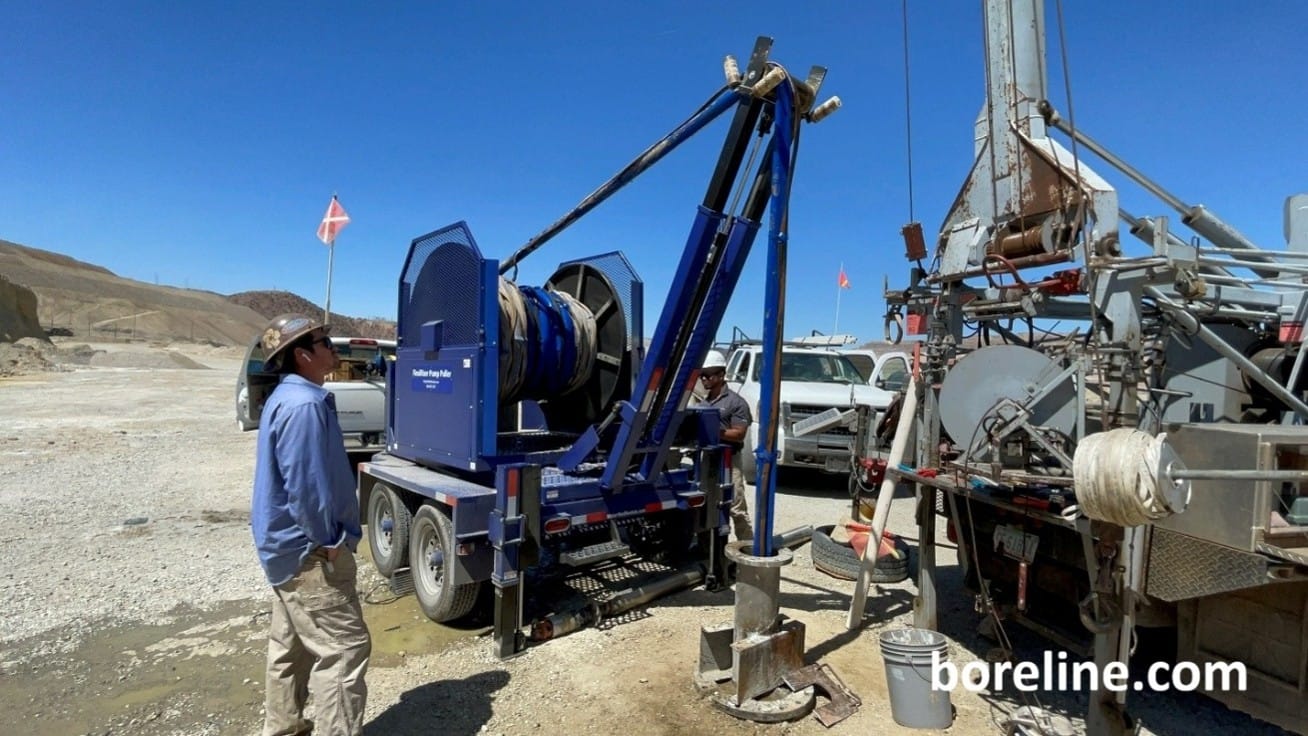
Boreline FlexiRiser and the FlexiRiser Pump Puller
Related Posts