There’s No Silver Bullet, But There is Hose From E&MJ – August 2025 Boreline FlexiRiser…
Why water wells produce less water
Water Flows where Boreline goes
I first started working in the groundwater industry in 1990 and since then I have not met anyone who installed their submersible pump on steel pipe and after 5 or 10 years are still producing the same GPM as when they first installed their pump. If you are one of these people, it would honestly pay you to spend a few minutes reading this because this is going to save you a bunch of money.
Why do we lose production and what can we do about this?
There are three reasons we lose production. It could be due to a) Changes in the aquifer, b) Changes in the pumping equipment, or c) Changes in the well itself.
Changes in the aquifer occur when there is a drop in the water level in the aquifer itself. This occurs because more water is being pumped out of the aquifer than is entering the aquifer.
The San Joaquin Valley in California, is one of the most productive agricultural regions in the USA and a major producer of fruit, nuts and dairy. Most of the irrigation occurs during the summer and most of this water is pumped from water wells drilled deep into the Tulare Basin aquifer.
During winter, snow falls on the Sierra Nevada mountains to the east and as spring comes around, a lot of the snow melts and flows into the ground, replenishing this aquifer.
When a drought occurs, this can have a negative impact on the water level in the aquifer and when this occurs, the Pumping Level in the well keeps dropping. A lower Pumping Level means that you have to lift the water further up the well so your pump is now using more horse power to overcome this extra lift. The result is less power to produce water which means less water comes out of the well.
Every pump has its own Pump Curve and looking at the Head-Flow curve below, the pump curve has Head (ft) on the vertical axis and Production (gpm) on the horizontal axis. The curve represents a kind of “give and take” as the pump will always operate somewhere along this curve.
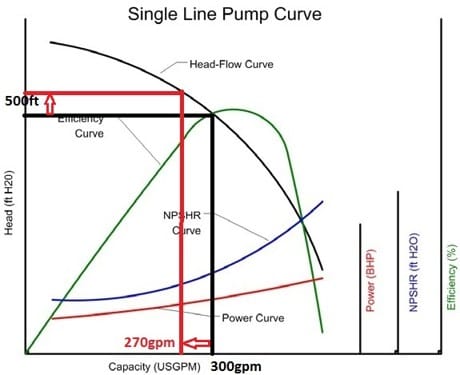
Every pump has its own pump curve along which it performs
As we start pumping we have a point on the curve that has a fixed height (500ft) with a corresponding gpm (300gpm). As the Pumping Level drops, you have to pump more head, so you move up the vertical axis to say 550ft. You now have to move horizontally across until you touch the Head-Flow curve and then move vertically down. In this case, you can see that you are now pumping less than 300gpm, which means you are producing less water.
There is not much you can do about this in the short-term and the only way to make up the shortfall is to pump for more hours, and that means more electricity to run your pump.
Changes in the pumping equipment is the second reason we lose production and this happens when we have a problem with the pump or drop pipe.
In the case of the pump, this could happen when the pump or motor runs out of plumb or there is damage to the impellers.
In the case of the drop pipe, there could be corrosion and/or holes in the steel pipe. During pumping, water that is pumped up just blows through these corroded holes and the result is an inefficient pump system that is just dumping lots of water straight back down the well. Again the result is less production coming out at the top of the well.
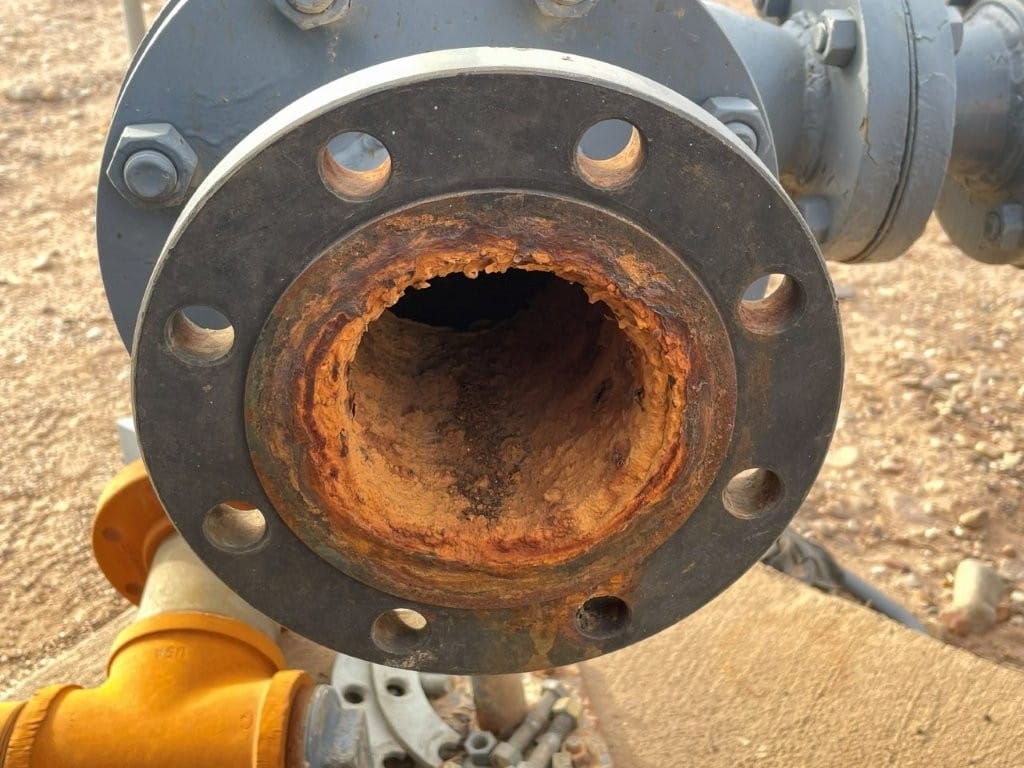
Internal scaling causes a drop in performance and costs you pumping time and lots of money
A pipe with internal scaling due to high mineral content, has a rougher internal surface than when it was new. The rougher surface that occurs over time causes friction and drag on the water. Think of a ship sailing through the sea with a lot of barnacles stuck to the hull; this is very inefficient.
In the case of a submersible pump, this extra friction causes the same movement along the pump curve because again we have to overcome more friction, which is the same as overcoming more head; the result again, is lower production.
Changes in the well screen is the third reason we produce less water. In this case, the well screen has become blocked up with scale. As we pump water out of the well, less water enters the well through the screens that are now blocked. In this case, the Pumping Level again drops and we know that means lower production.
Monitor and Measure to Maintain
What we can do to prevent a drop in production is to monitor and measure to maintain the production. As soon as we measure a drop in production approaching 10% of the original production rate, we should pull the pump out of the well and check out what is happening.
With steel pipes, we cannot stop internal scaling but once we notice a drop in production, we can remove the pipe from the well and clean the inside, bringing it back to its original state as when we first installed it.
This is often not feasible as pumps need to be switched off and pulled out of the well, replaced and the entire column installed again. This is time-consuming and can takes days to complete and costs a lot of money.
What options do we have?
Boreline FlexiRiser from Hose Solutions is designed to replace the rigid pipes used with submersible pumps. Boreline is totally non-corrosive so you will never lose production due to corrosion.
Another big advantage of the Boreline FlexiRiser is that it is self-cleaning and over time there is no internal scaling that occurs. When the pump switches on and off, the movement in the pipe causes all internal scaling to break off, resulting in a smooth surface from day one, for the life of the well. No loss of production.
Boreline FlexiRiser is also available in one, continuous length. This means there are no joints or couplers from top to bottom. This is a big advantage because with Boreline FlexiRiser, you don’t have to spend all day screwing and unscrewing 20ft sticks of steel pipe.
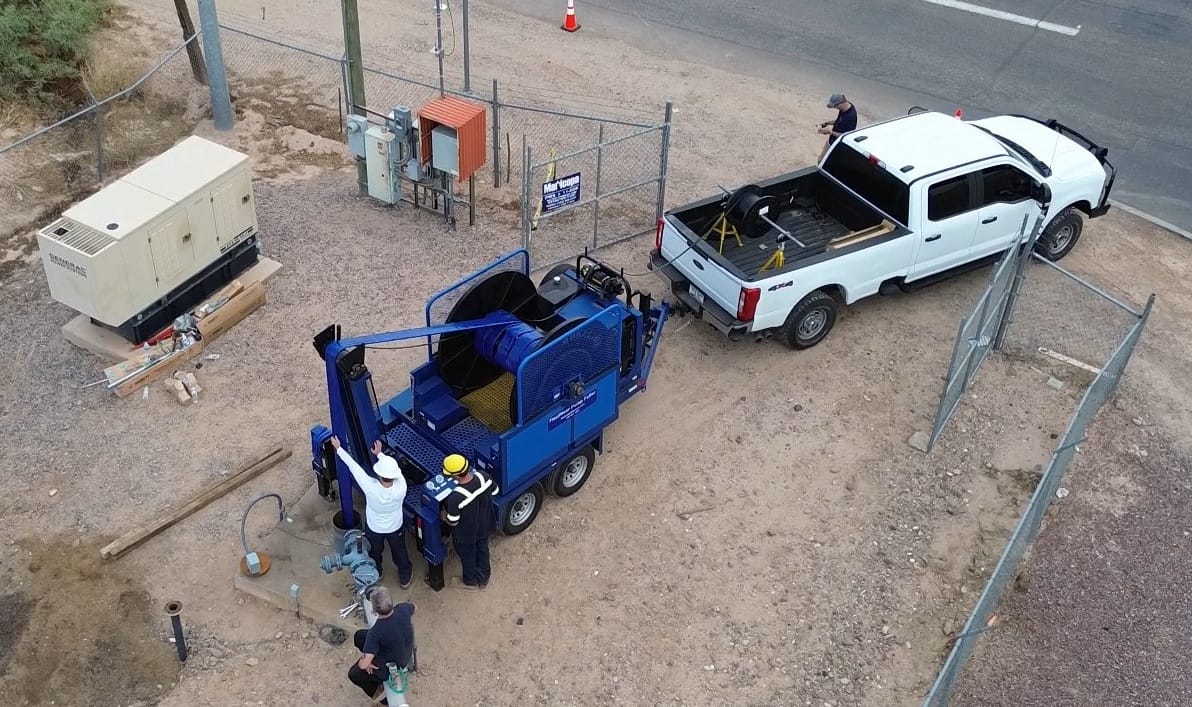
The FlexiRiser Pump Puller has a small footprint and only a couple of operators
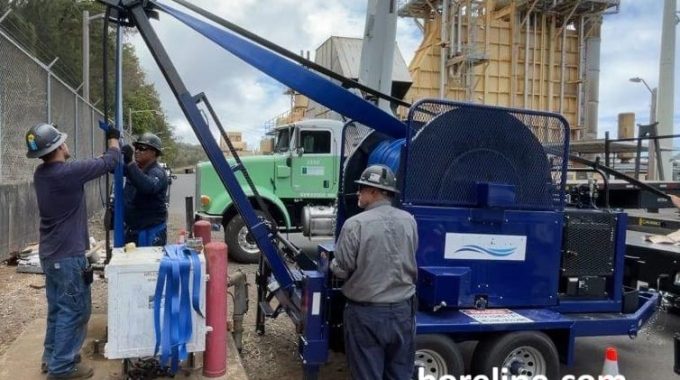
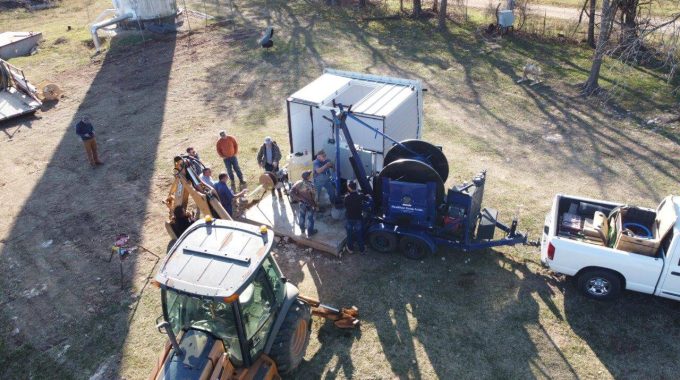
A very cool piece of equipment that is ideal to work with Boreline is the FlexiRiser Pump Puller. This is a diesel-driven, trailer-mounted, hydraulic spool-system that can install and retrieve submersible pumps at the push of a button. You just back-up the Pump Puller and position it over the well. As you pull the pump up, the Boreline and the power cable all roll up together, allowing you to pull a continuous length quickly, safely and efficiently. No working under heavy loads and almost no handling of the Boreline from start to finish.
With a pump set on Boreline FlexiRiser, when it comes to servicing the pump, it is now a lot easier to just pull the entire column from the well and roll it up onto the FlexiRiser Pump Puller.
Why are we not servicing wells to prevent loss of production?
The simple reason submersible pumps are not being changed out is that it is tough, time consuming and expensive to pull a pump set on rigid steel pipe.
Rather than change out the pump, we just leave the pipe in place and over time, we continue to lose even more production. And when do you think that pump be pulled? When it eventually totally stops running.
This is called “Run to Fail” and while this may sometimes make sense, 90% of the time it will cost you considerably more to operate in this manner. Think of it like this ….. for every 20% loss of production, you need to run for 20% more time. It is that simple.
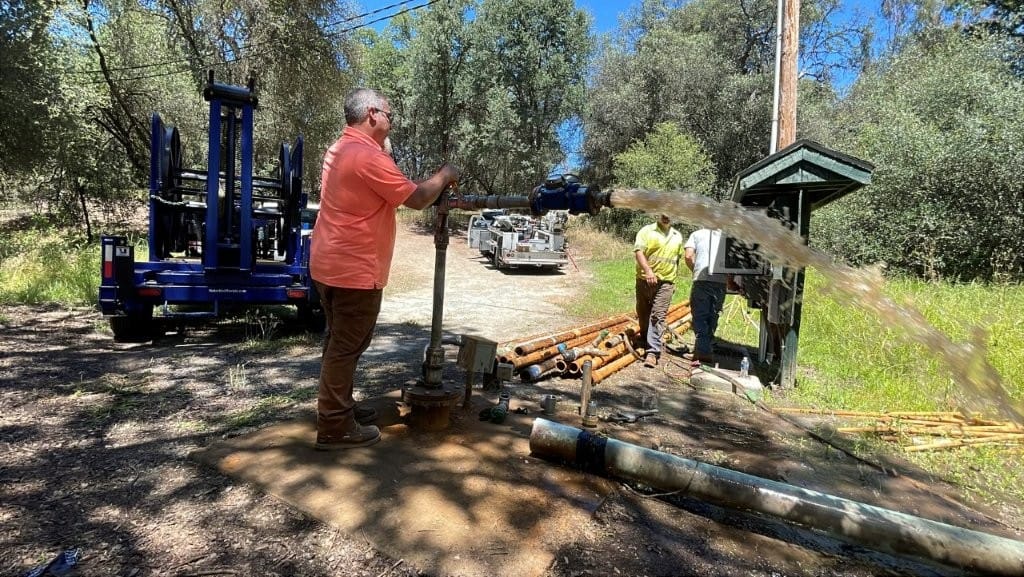
Production increased 15% when this Rural Community installed their pumps on Boreline FlexiRiser
If these pumps were set on Boreline FlexiRiser, it is not a problem to pull and change out the faulty equipment. Pulling a submersible pump that is set on Boreline FlexiRiser is a “minor inconvenience” because pumps can now be changed out in a matter of hours rather than days.
So give us a call or talk to your contractor about Boreline FlexiRiser. Those forward-thinking pump contractors are the ones who will understand that you will not be replaceming pipe like you used to and that they will be billing you less to pull and set pumps. But these are the contractors who will be around in the future as this industry continues moving to improve efficiencies, adapt to new technologies, accommodate the new generation and continue finding ways to complete more work with fewer resources.
Boreline FlexiRiser is a no-brainer and if you still have any doubt about that, please call us and we will show you how much you can save from day one.
We have worked with big cities and small rural communities across the country. Those who have installed their pumps on Boreline FlexiRiser are saving tens of thousands of dollars per year and using those funds to invest in other areas of their utility or give a better bonus at year-end !
It’s time to make the move to Boreline FlexiRiser and for the smaller diameter shallow settings, please check out our WellHose EASY Drop Pipe.
www.Boreline.com +1 480 607 1507
Related Posts